
The Full Arc of Learning: Why We Ask Students to Present, Then Pause
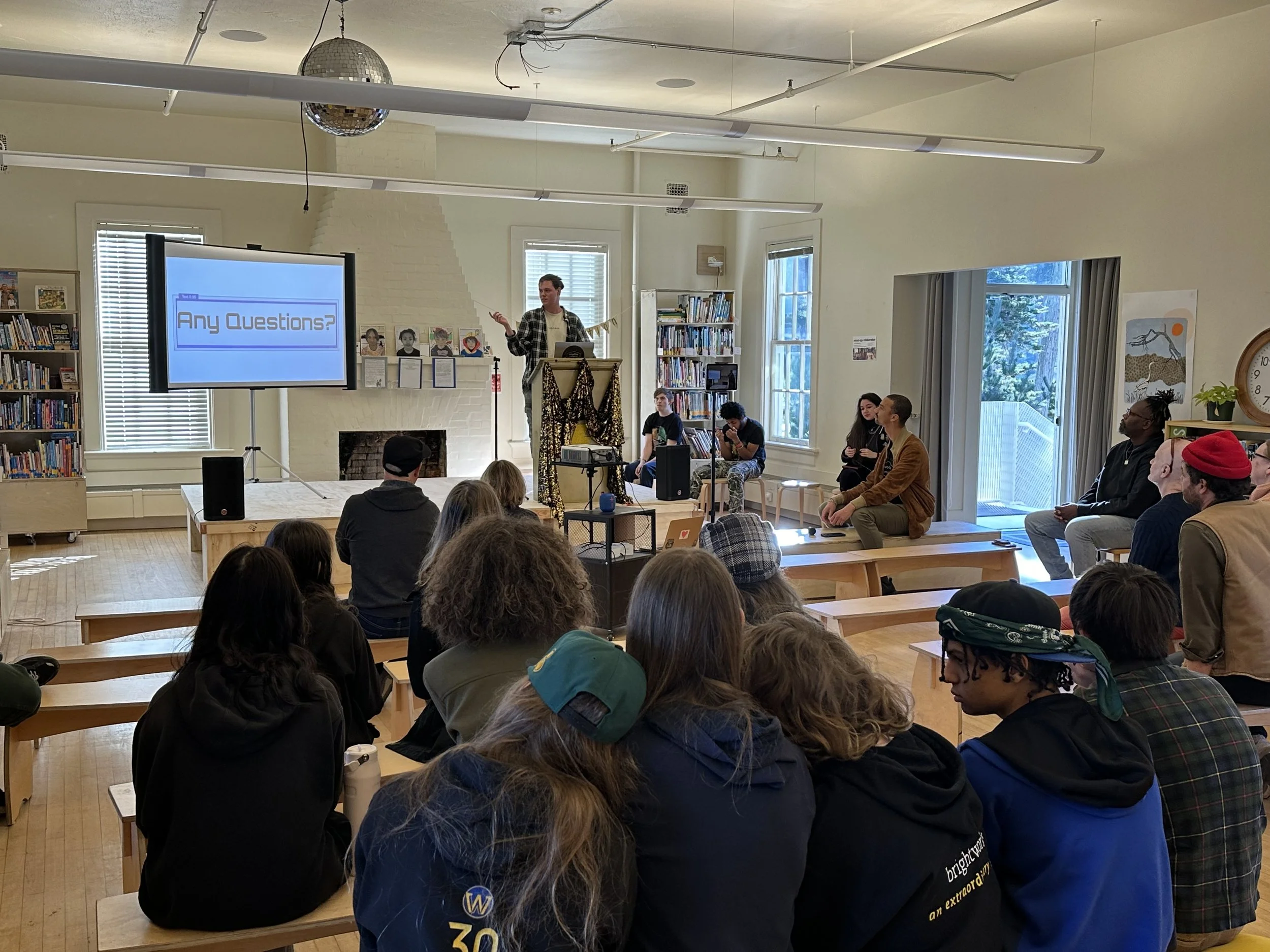

If you walk through the Brightworks building this week, the energy is palpable. You might see an eight-year-old clutching index cards with determined focus, or a high schooler refining the slide transition on a data visualization.
It is Exposition Week—the culmination of weeks of deep diving, iterating, and discovery.
In a traditional setting, a unit of study often ends with a test: a solitary act of recalling information. At Brightworks, we believe the highest form of learning isn't retention; it is synthesis. That is why our curriculum culminates in two parts:
Exposition—a moment where learners explain their work to their community, answer unscripted questions, and own their expertise.
And Reflection —the quiet work of interrogating their learning process.
Here is how this week positions our students for success, not just in school, but in the world beyond.
The Art of "Going Public"
There is a profound shift that happens when a student moves from "learning about a thing" to "explaining that thing to the community."
Exposition challenges learners to take the messy, complex process of their project work and distill it into a narrative. This develops robust, flexible communication skills. It teaches them that having a great idea is only half the battle; the other half is communicating that idea with clarity and grace.
When a student stands up to present, they are practicing the essential life skill of advocacy. They are learning to say: “I made this. Here is why it matters. Here is what I learned when it failed.”
A Developmental Journey
One of the joys of Exposition Week is watching the trajectory of growth across the "bands" (age groups).
In the Early Years: Success looks like conversation. Our youngest learners might prepare specific answers for a Q&A format, learning that their voice deserves to be heard and that adults are interested in their thoughts.
In the Middle Years: The scaffolding fades. Learners begin writing their own scripts, organizing their logic, and practicing the art of engagement.
In High School: We see the emergence of the "TED-style" talk. Students are expected to craft compelling narratives, manage complex visual aids, and hold the room with authority. Their projects span the full year. So their winter presentations serve as mid-project feedback sessions with invested community members.
Expo Night: A Marketplace of Ideas
While daytime presentations focus on the spoken word, Expo Night transforms the school into a living, breathing marketplace of ideas.
As families, experts, and community members flood the space, the school feels less like a classroom and more like a bustling design studio or science museum. Students stand by their physical displays—their prototypes, their art, their machinery—ready to engage.
This environment mimics the real world of professional exchange. Students must read their audience, pivoting their explanation depending on who is asking (a peer vs. a grandparent), and handle the vulnerability of answering unscripted questions. It is a celebration not just of what they made, but of the experts they have become.
The Power of the Pause: Reflection
We do not learn from experience. We learn from reflecting on experience.
– John Dewey (1933)
Once the applause fades and the displays are taken down, we do not immediately rush into the next topic. Instead, we enter a critical phase often skipped in traditional education: Reflection.
The week following Expo is dedicated to the "quiet work" of learning. We believe that experience alone doesn't teach us; reflecting on experience does.
During this time, students organize their portfolios, curate photographs of their process, and document their journey. They engage in "meta-cognition"—thinking about their own thinking. They ask themselves: Where did I get stuck? How did I solve that problem? What would I do differently next time?
By documenting their process, students internalize their growth. They leave the arc with more than just a grade; they leave with a deeper understanding of how they learn best. This ability to self-assess and pivot is perhaps the most critical skill for success in an ever-changing world.
We’ve seen the results year after year, since 2011. Students who enter with uncertainty blossom into confident learners who understand what motivates them. They leave Brightworks with portfolios full of work that reflects their growth, passion, and thoughtfulness—not just grades and test scores.
Interestingly, the Brightworks approach to learning affords graduates the dual-benefit of knowing themselves and building the academic skills to thrive in more traditional schools. We see this reflected in their post graduation paths.
Our 2025 8th grader Graduates gained acceptance to some of San Francisco’s most competitive independent schools, including:
University High School
Lick-Wilmerding High School
Urban High School
Bay High School
Ruth Asawa’s School of The Arts
Drew
Lowell High School
and many more.
If you’re looking for a school that sees your child for who they are—and who they are becoming—we invite you to learn more about Brightworks.
Because success should look like your child, thriving.