
Drums, Red Envelopes, and New Beginnings: Celebrating Lunar New Year at Brightworks

At Brightworks, we love a celebration that engages the senses. If you walk past our campus next week, you might hear the rhythm of drums and the clash of cymbals echoing through the parking lot.
It is time for the Lunar New Year—a season of renewal, family reunion, and sweeping away the old to make room for the new.
While our curriculum is driven by the arcs of our projects, our culture is driven by the traditions of our families. We believe that global citizenship starts with celebrating the cultures represented right here in our own community. This week, our students are learning that the Lunar New Year is celebrated by millions of people across Asia and the world, each with their own unique food, traditions, and hopes for the year ahead.
Save the Date: The Lion Dance
We are thrilled to announce that the Lion Dancers from Lion Dance Me will be returning to Brightworks!
In Chinese tradition, the lion signifies courage, stability, and superiority. The dance—performed by skilled dancers under a single costume—is accompanied by loud music meant to scare away bad luck and evil spirits, ensuring a fresh start for the community.
We invite all families to join us for this vibrant performance:
When: February 18th
Time: 9:30 AM (Sharp!)
Where: The Main Parking Lot
Who: All students and families are welcome.
A Note on Noise: The Lion Dance is joyful, but it is also loud! The drums and cymbals are an essential part of the tradition. If your learner is sensitive to loud noises, our collaborators will have noise-canceling headphones available, and we will have a designated "quiet viewing zone" set back from the main action.
Wishing You Prosperity
Whether you are celebrating the Year of the Fire Horse with a family feast, exchanging red envelopes (hongbao), or simply taking a moment to reflect on your goals for the spring, we wish you happiness and prosperity.
We look forward to gathering together on the 18th to welcome the good luck—and scare away the bad—as a community.
Background
In 1847, San Francisco was a sleepy little village known as Yerba Buena with a population of 459. With the discovery of gold and the ensuing California Gold Rush, by 1849, over 50,000 people had come to San Francisco to seek their fortune or just a better way of life. Among those were many Chinese, who had come to work in the gold mines and on the railroad. By the 1860’s, the Chinese were eager to share their culture with those who were unfamiliar with it. They chose to showcase their culture by using a favorite American tradition – the Parade. Nothing like it had ever been done in their native China. They invited a variety of other groups from the city to participate, and they marched down what today are Grant Avenue and Kearny Street carrying colorful flags, banners, lanterns, and drums and firecrackers to drive away evil spirits.
Since 1958, the Parade has been under the direction of the Chinese Chamber of Commerce. When KTVU, Channel 2, started televising the Parade in 1987, the Chinese Chamber of Commerce realized that although the Parade would still represent the community, its growth would demand a commitment to higher quality and corporate sponsorship involvement. The Chinese New Year celebration was expanded to a month-long Festival including two street fairs, a basketball jamboree, a public art project and the Miss Chinatown U.S.A Pageant & Coronation Ball.
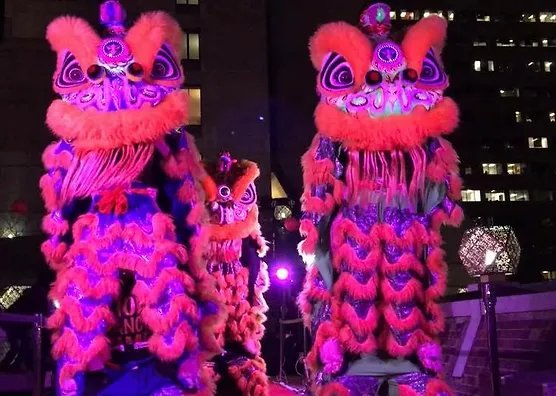
Today, the San Francisco Chinese New Year Festival and Parade is the largest celebration of its kind in the world,
attracting over three million spectators and television viewers throughout the U.S., Canada, and Asia with the help of both KTVU/Fox 2 and KTSF, Channel 26 (Chinese broadcast).
Named one of the top ten parades in the world by the International Festivals & Events Association, the Chinese New Year Parade in San Francisco is one of the few remaining illuminated parades in North America and the biggest parade celebrating Lunar New Year outside of Asia.
The parade still welcomes a variety of other groups to join in the march, and still hopes to educate, enrich and entertain its audience with the colorful pageantry of Chinese culture and tradition. In order to retain the integrity of the Parade, participants are asked to tie their float or specialty unit to a Chinese cultural theme. We are honored and delighted to have representatives from other Asian cultures participating in this year’s festivities.